Anyone who’s spent time in NSW’s Illawarra region will no doubt be familiar with the sight of paragliders floating across the sky. The town of Stanwell Tops, perfectly situated on the coastline’s cliff face, is home to a popular lookout and launch site for paragliders. The sky fills with colourful parachutes on clear days.
One of these parachutes will often belong to Ken Hutt, a 61-year-old retired police rescue officer, who took up paragliding as a hobby when he retired. But when the local sights of Stanwell Beach became commonplace, he set his goals much higher.
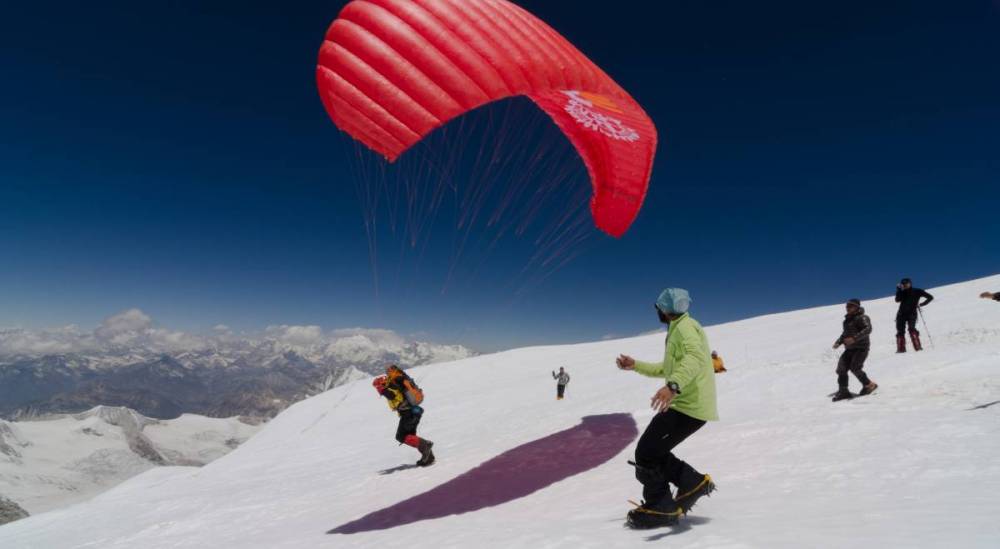
Six years ago, at the age of 55, Ken travelled to Tibet to conquer Cho Oyu, the sixth-highest mountain in the world, trekking up and paragliding back down. Having successfully completed that goal, once again the only way was up.
“After flying from an 8,200-metre mountain, what else do you do? You’ve got to go higher, so Everest is the one,” Mr Hutt told the ABC.
Planning to scale the world’s tallest peak in March, Ken is hoping to be the second person ever to successfully paraglide off the side of Mount Everest.
“The intention is to glide from as near to the summit as conditions will allow and fly back down to a town called Gorak Shep, which is the nearest village to Everest base camp.
“I guarantee this is going to be the last mountain climb, because I’m 61, back in training again, and finding it harder and harder to get up those hills.”
The only other person to successfully paraglide off Mount Everest was a local Sherpa. If he is successful, Ken would be the second ever, and the oldest person to paraglide off the mountain.
“Most people aren’t successful on Everest, so I’m probably a little bit optimistic,” Mr Hutt said.
“But there’s no point climbing a mountain unless you’re optimistic and unless you’re going to give it a good shot.”
Supported by oxygen and a team of ten, Ken and paraglider trainer, Mark Mitsos are all too aware of the risks.
“In Australia, we’ve got lots of visual cues: you’ve got the terrain you’ve got the clouds you’ve got the ocean to tell you what the wind’s doing, you’ve got the hill that you’re flying near, you’ve got the people that you’re flying with,” Mr Mitsos told the ABC.
“In the mountains, it’s white, it’s high altitude, sometimes you can’t see the ground, there could be cloud cover, it’s cheese and chalk.
“On Everest, you’re so high up, and the air is really thin, whereas here, we’ve got thick maritime air and everything happens very slowly and predictably.”
This daring expedition isn’t just for kicks. Hutt is taking the plunge to support and raise money for the Rotary campaign to end polio around the world.
The highly infectious disease was declared eradicated in the Western Hemisphere in 1994, but is still infecting children in Pakistan and Afghanistan. Most common in children under five, polio can cause paralysis, sometimes to the chest and lungs causing death if breathing assistance isn’t administered.
While Hutt waits for Nepalese Prime Minister, KP Sharma Oli, to approve the dangerous expedition, you can find him in the skies of Stanwell Tops, floating in his eye catching, bright red ‘End Polio Now’ parachute.
Image Source: Rotary Down Under Facebook


