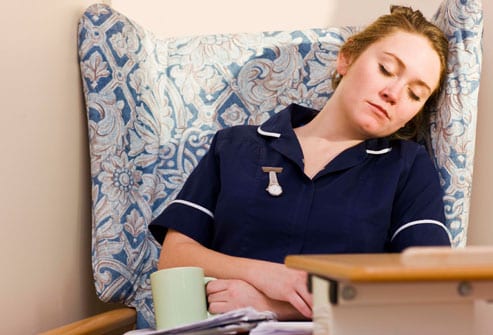
It’s not uncommon to see healthcare workers putting the health and well-being of others before their own. This means sacrificing food, time and sleep.
Sleep deprivation is an unfortunate reality of being a shift worker – especially for nurses and aged care worker.
Working long shifts, even some back to back and at off hours can do significant damage to a person’s health.
A new video has explained the extreme and detrimental effects that sleep deprivation can have on a person.
The Tech Insider video features Mathew Walker, professor of neuroscience and psychology at the University of California, Berkeley – and the video has gone viral, being viewed more than 794,000 views on Youtube.
Do you even find you have trouble remembering on days where you slept poorly?
Walker says that there is a reason for that, “a lack of sleep will actually prevent your brain from being able to initially make new memories, so it’s almost as though without sleep the memory inbox of the brain shuts down and you can’t commit new experiences to memory”.
“You end up feeling amnesic, you can’t essentially make and create and make those new memories.”
Walker even suggests that the lack of sleep can actually increase the risk of Alzheimer’s disease – a condition these aged care workers are caring for every day in their residents.
“It is during deep sleep at night when a sewage system within the brain actually kicks into high gear and it starts to wash away this toxic protein, beta amyloid,” says Walker.
“So if you’re not getting enough sleep each and every night, more of that Alzheimer’s-related protein will build up.”
“The more protein that builds up, the greater your risk of going on to develop dementia in later life.”
The lack of sleep can also increase the risk of other conditions – and can negatively impact the reproductive system and immune system.
“After just one night of four to five hours of sleep, there is a 70 per cent reduction in critical anti-cancer-fighting immune cells called natural killer cells”.
“And that’s the reason that we know that short sleep duration predicts the risk for developing numerous forms of cancer. That list currently includes cancer of the bowel, cancer of the prostate and cancer of the breast”
“In fact, the link between a lack of sleep and cancer is now so strong that the World Health Organisation decided to classify any form of nighttime shift work as a probable carcinogen.”
“We also know that a lack of sleep impacts your cardiovascular system, because it is during deep sleep at night that you receive this most wonderful form of effectively blood pressure medication.”
“Your hate rate drops, your blood pressure goes down. If you’re not getting sufficient sleep, you’re not getting that reboot of the cardiovascular system, so your blood pressure rises.”
“If you’re getting six hours of sleep or less, [you have] a 200 per cent increased risk of having a fatal heart attack or a stroke in your lifetime.”
Clearly, there is enough evidence to show the importance of sleep and good health. And for aged care workers and nurses, not getting enough sleep can be both detrimental to their own health and the care that they offer residents.
What do you have to say? Comment, share and like below.



I don’t believe we all have exactly the same sleep requirements, nor that our metabolisms are so similar. My natural sleep period is five-and-a-half hours, and if I try to sleep longer I wake heavy and dull. Trying to make everyone conform to an average pattern may do more harm than good. I know people who need much more sleep than I do, and I have heard of many who need far less.