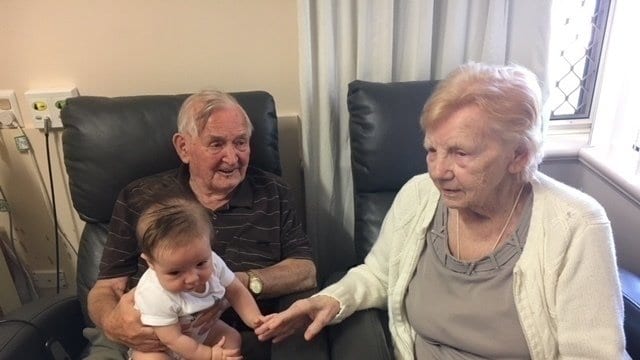
Should nursing homes give priority to residents who can afford to pay for aged care, even if it means frail and elderly couples are separated?
A perth nursing home is refusing to grant an 87 year old man a bed in the home where his wife of 68 years lives because the home is giving priority to paid places.
Six months ago, Alf Craster, 89, had a fall, and was taken to Fremantle Hospital.
When his family asked if he could join his wife, Hetty Craster, 87, in her nursing home, they were told that priority for beds would be given to those who can afford to pay for it. Mr Craster has a health care concession from the government for a place in a nursing home.
The couple’s daughter, Elizabeth, has spoken to the CEO of the nursing home, reports The Daily Mail, and was told that priority would be given to a fully funded applicant who can afford to pay $325,000. She is asking that the couple be allowed to reunite.
“How do you explain to an 87 and 89-year-old that a system doesn’t know anything about them and wants to keep them apart?” she told 9News.
“It’s wrong on so many levels,” she said.
Mr Craster’s name has been on the waiting list at the nursing home for six months, but he hasn’t been given any indication of whether he will be able to move back in with his wife.
He is currently being looked after at a transitional care facility with 24-hour care because his health is deteriorating.
“I don’t know why I can’t be with her. She loves me and I love her,” Mr Craster told 9News.
Mrs Craster has dementia, and the only person she recognises is her husband. She sits beside his his empty chair at the nursing home.
Elizabeth has created an online petition and already has 3,000 signatures, reports 9News. The petition will eventually go to the Minister for Aged Care The Hon Ken Wyatt.
A spokesperson for the Minister for Aged Care, Ken Wyatt, told HelloCare that the Minister has been working with the Cranston family since last week, and he has asked the Older Persons Advocacy Network (OPAN) for a report on the situation.
“I sympathise with Mr and Mrs Craster and their family, and all families who face these challenges,” the Minister said in a statement. “I understand the sadness and trauma of separation.”
“No one wants to see couples separated,” he said.
The Minster said the situation in part reflects the shortage of aged care beds in Western Australia, and that 3,295 new beds being built in the state will help meet growing demand.
The Federal Government has put $25.7 million towards establishing and funding OPAN.
Danielle Robertson, Founder and CEO of DRC – Care Solutions, said she recently worked with a couple who said “they would rather die than move in separately”. She was able to find them a facility that accepted them both – aged 93 and 94 years old. The couple were not prepared to move until they found a place with two rooms side by side.
“We got one room with the two single beds and the second room next door is set up as a living room. They are at the end of a corridor so don’t have people walking past the entire time so it’s like their own little apartment with a shared bathroom,” said Robertson.
“That was a good outcome,” she said. But some are not so lucky.
We hope the Cranston family can find a way to keep the elderly couple together. Have you had an experience when a couple has been forced apart due to the bureaucracy of the aged care system?





