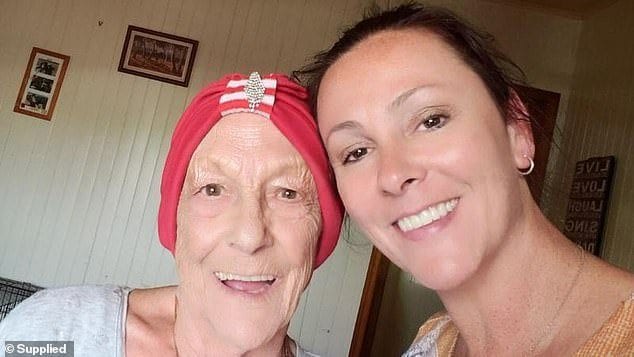
Australian woman Nicole Sadilek, flew home from the United States to be with her dying mother, only to be denied special exemption.
Nicole and her seventeen-year-old daughter Paige, had applied for the exemption prior to leaving from San Francisco last week.
They hoped to spend two or three days confined in a Sydney hotel, and then be allowed to isolate in Mrs Salidek’s sister’s home in Ipswich, Brisbane, so that they could see their mother and grandmother through the window during her final days.
Nicolette Hammond, mother of Nicole and grandmother of Paige, was first diagnosed with lung cancer last year, since metastasising to her liver.
Along with this, Mrs Hammond suffered a bad fall on June 15 and broke her hip, further increasing her fragility.
On Wednesday night, Queensland Health authorities let Nicole and her daughter know that their request had been denied, stating that their case did not constitute ‘exceptional circumstances’ and that they must endure the full 14 days of quarantine.
This begs the question, what does exceptional circumstances encompass, if not the imminent passing of a mother?
Adding to these unfortunate events, the mother and daughter duo missed their connecting flight from Sydney to Brisbane, owing to delays due to COVID-19. This flight would have allowed them to quarantine closer to their dying loved one.
This scenario provokes discussion, as it is not an isolated one and has lasting impacts, both physically and mentally to the multiple parties involved.
There are many stories of family members being forced to stay in quarantine, while a loved one battles through their last days on earth.
Some, have passed during these extreme quarantine measures, without a chance to say a last goodbye.
But then we must consider the admirably low amount of cases in Queensland, with on 2 new cases in the last 24 hours and a total of 6 lives lost throughout the entire pandemic.
Understanding the pressure placed on governments to be extra cautious, to keep cases down and their state in good health and economy, however proof of a close family member’s rapid demise seems inhumane to ignore, or deny without explanation or discussion.
Although Queensland Health haven’t been reported to comment on Nicole Sadilek’s individual case, they’ve stated that every rejection or approval I made with the applicant’s ‘safety in mind’.
‘Currently only Australian citizens, residents and immediate family members can travel to Australia,’ the department said in a statement.
‘All travellers from overseas are required to quarantine for 14 days when they arrive in Australia. This is a federal government decision.
‘These are difficult decisions and we understand being separated from loved ones, especially those who are unwell, is an extremely difficult circumstance to be in.
‘The compulsory quarantine period being used in Queensland, consistent with that of our state and international peers, is there to protect our community from the ongoing international COVID-19 pandemic.’
Mrs Sadilek’s exemption was denied based on federal government rulings.
We must ask ourselves as human beings, how important it is for us to stay safe, for ourselves, the rest of humanity and our future, as well as the importance of our loved ones and their place in our lives. Let us never take each other for granted.



There are a couple of pertinent points to note here. Firstly, their mother/grandmother had been terminal for months yet they did not seek to come to Australia until the last minute. Secondly, the USA is currently a significantly high risk country with ongoing community transmission and few controls in place. Third, I have compassion that they did not see their loved one; but their presence or absence did not affect the outcome for their mother/grandmother. However, their ability to circumvent the quarantine could well have had a huge impact on others should either or both of them have Covid-19. There is a very real possibility that they could inadvertently have been responsible for the illness and possible deaths of innocent people if they did indeed have the virus. As a society, we are not learning the lesson about selflessness here.
How much more a risk than all the footballers from Victoria ( a high risk area ) that were given the OK?