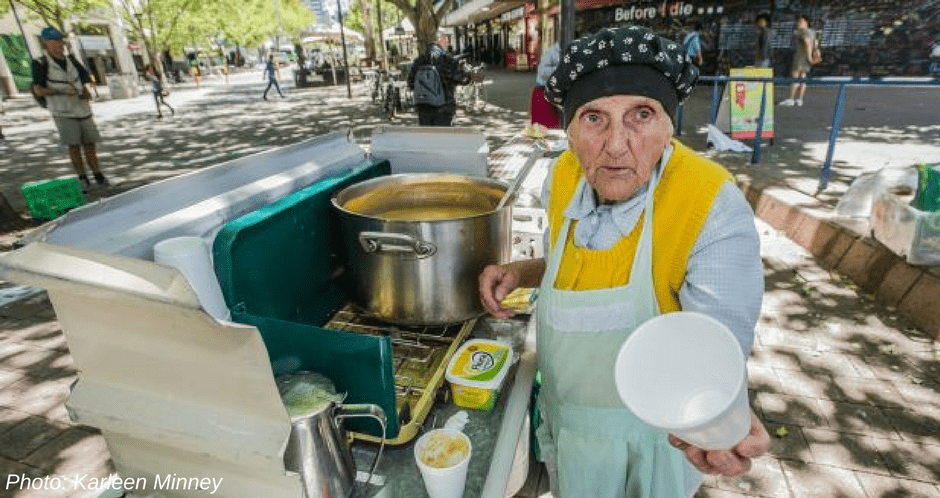
“Everything in life I share. Just like you are hungry, I can give you something. Love in action. Do something. Take something. Move something.”
Stasia Dabrowski makes a mean soup. Every Thursday she prepares nearly 200 kg of vegetables to serve to the hungry on Friday.
Last month, Stasia wrote off the soup kitchen van when it clipped a railing on Hindmarsh Drive. No one was hurt in the accident, however, the van only had third party insurance which left Stasia without a vehicle.
Since 1979, Stasia has been running her mobile soup kitchen in Garema Place, Canberra.
For 38 years she has served soup, along with sandwiches, sweet buns and donuts, from a foldout table underneath a canopy of trees.
Stasia is, in the meantime, using her grandson’s 2001 Holden Astra.
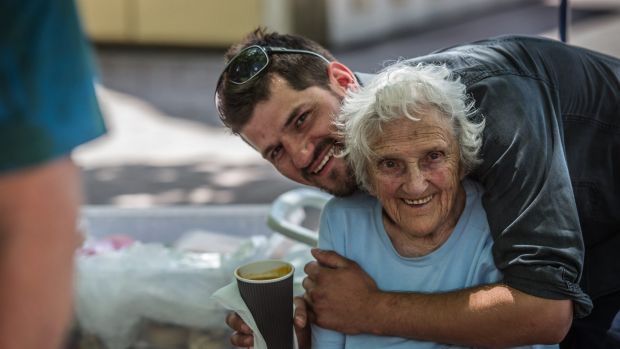
Her grandson, Josh, has been helping her with her mobile soup kitchen since he was 5 years old – peeling vegetables for the soup.
That was 22 years ago, and he’s been helping her ever since.
Josh’s former partner suggested that Josh and Stasia start up a GoFundMe campaign to help raise money to buy a new van. In one month they’ve been able to raise more than $35,000, which is nearly four times their initial target of $8 000.
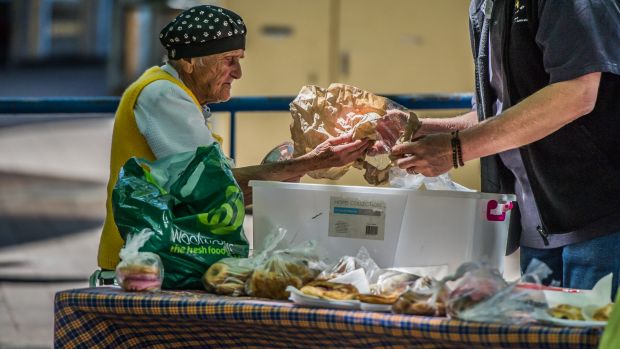
Despite the loss of the van, which will easily get replaced thanks to the money raised on GoFundMe, she still takes part in the daily bread and vegetables runs, makes the sandwiches and soup for Friday, as well as deliver food to clients of a local Canberra methadone clinic.
She’s a local celebrity, dubbed “Canberra’s soup kitchen lady”, and over the years has been awarded the 1996 Canberra Citizen of the Year, the 1999 ACT Senior Australian of the Year and most recently the 2017 ACT Local Hero of the Year.
She’s even carried the Olympic torch. Stasia’s soup is so good, it inspired a local musician, by the name of Rafe Morris, to write a song about her – “Soup kitchen lady”.
Needless to say, Stasia has touched a lot of lives.
Stasia was born in a mountain village in southwest Poland, only a few kilometres from the border of Czechoslovakia.
As a child she moved around between neighbouring villages until the Ukrainian fascists’ ethnic cleansing campaign persuaded Stasia’s father to borrow a wagon from neighbours, take the family and leave almost everything behind.
During WWII, Stasia left school and worked as a maid for a German doctor and his wife. The doctor and his wife both spoke Polish, he would take Stasia with him at night when he secretly went out to help Polish people who needed medical attention.
The war ended the day after her 19th birthday. After the German in Poland left, Stasia worked as a secretary in a youth club. In 1946, at the age of 20, Stasia enrolled into nursing school.
In 1964, Stasia emigrated to Australia with her nuclear scientist husband, Jan Nurzynski, and their first child. Jan had been offered a job in the Department of Nuclear Physics at the Australian National University. When the family arrived in Canberra, ANU had a home ready for them in Dover.
Stasia later had two more children in Canberra. It was through a personal family tragedy that Stasia was exposed to drug addiction, homelessness and poverty – which later led to the conception of her mobile soup kitchen.
Stasia’s has lived through a war and moving to the other side of the world – the things she has witness has inspired her to do good, and created a passion to help and feed others has never wavered. The world needs more people like “Canberra’s soup kitchen lady”.


