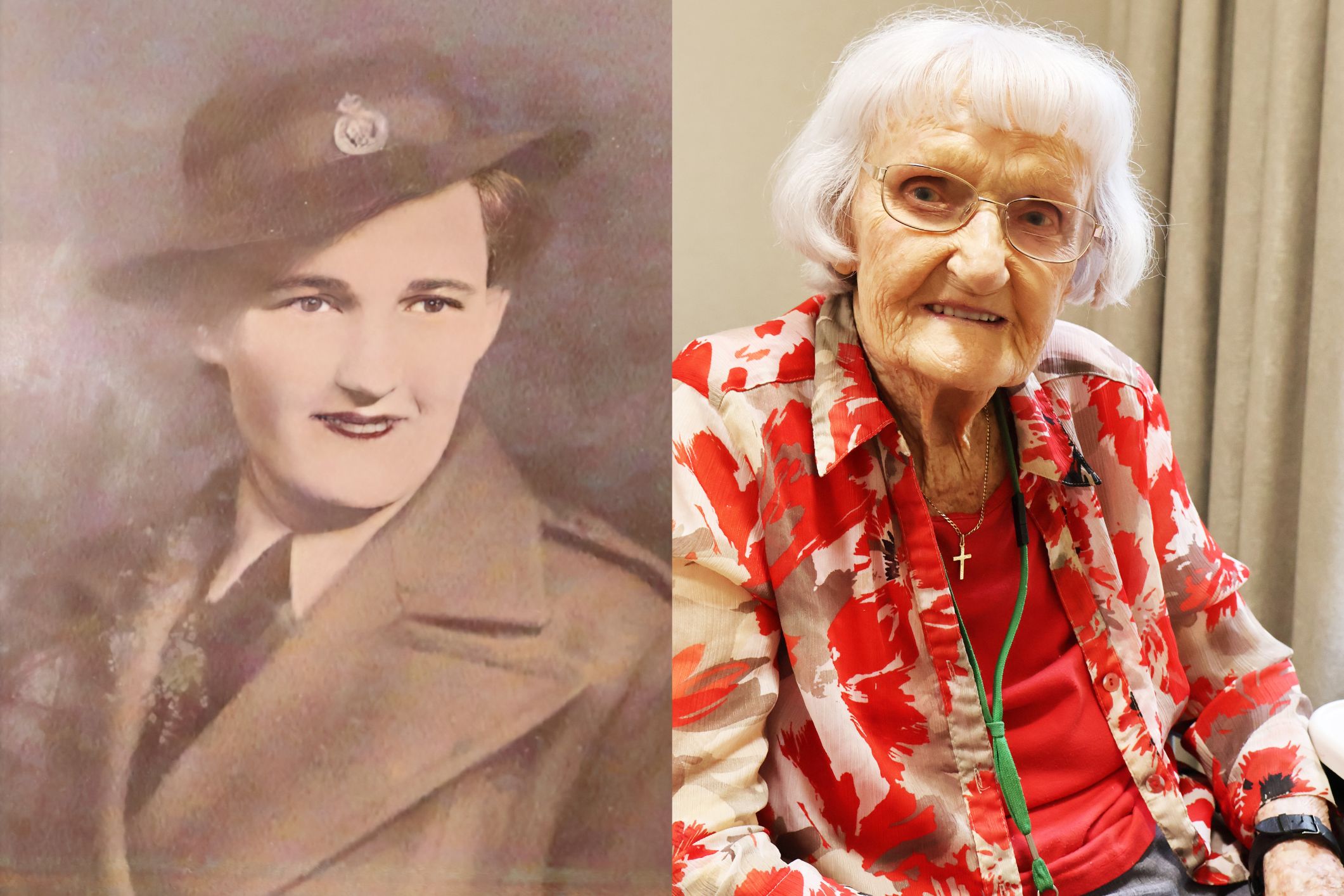
Mrs Irene Dixon, 101, describes her time in the Australian Land Army as ‘honest, hard work.’
Now a resident at Resthaven Port Elliot, Irene is believed to be the last surviving South Australian member of the Australian Women’s Land Army.
‘It’s not surprising really,’ she says with a wry smile. ‘Many of the women I was with were about 10 years older than me.’
Irene joined the Australian Women’s Land Army when she was 22 years old. World War II had broken out, and as the daughter of a farmer, she felt she could help with the war effort.
‘We did all sorts of seasonal work, picking fruit, or helping in factories to dry potatoes.
We went wherever we were needed. It wasn’t the type of work I was used to on the farm, as I was given the “girl” jobs at home.’
‘There was always a good fellowship among us workers,’ Irene says. ‘Everybody would do their bit. I can’t remember anyone ever getting into trouble for not doing the right thing. We were all hard workers.’
One of 11 children, Irene grew up on the far west coast of South Australia, in a town called Charra, located between Ceduna and Penong.
‘Two of my brothers joined the army,’ Irene says. ‘They wrote to let me know that the dried potatoes weren’t very tasty,’ she laughed. Sadly, in 1941 one of her brothers was killed in Tobruk.
Irene says things were different after that, and the family moved from Charra to Whyalla. While on holiday at Victor Harbor, Irene met her husband, John.
‘He was on leave from the navy, and two years after the war ended, we were married,’ Irene says. ‘Times were hard, but he was a lovely man and a loving husband. We were married for 75 years.’
Irene and John also lived in Whyalla for many years, but when their two children grew up and moved to Adelaide, Irene and John followed them to be closer to family.
Sadly, John died in 2022, and Irene decided it was time to move again. She moved into Resthaven Port Elliot and is very pleased she did. ‘It’s a beautiful place to live,’ Irene says. ‘I knew my life was going to change when I moved here.
I went from being very independent to receiving help for many things. But I decided to be graceful about it, and I have been treated with kindness and respect at every turn.’
Irene’s photos and some information about the Australian Women’s Land Army have been put on display at Resthaven Port Elliot, and on ANZAC Day this year, she will lay a wreath to remember those who lost their lives serving Australia.
Established in 1935, Resthaven is a South Australian not-for-profit aged care community service associated with the Uniting Church in Australia.
Every day, Resthaven shares the lives and wisdom of older people and their carers, opening doors to the full range of aged care service options available.
Services are provided throughout metropolitan Adelaide, the Adelaide Hills, Murraylands, Riverland, Fleurieu Peninsula, lower Barossa region and the Limestone Coast of South Australia.


