
This time last week, Four Corners showcased the human wreckage being caused by the aged care system’s Integrated Assessment Tool’s algorithm which is used to allocate funding to seniors accessing care in the home through the Support at Home Program.
This investigation was damning. Highlighting mechanisms that weighted things like dementia and illness so lightly that people who required the highest levels of care were not able to qualify for high level funding and left to languish.
What that investigation didn’t have was the algorithm’s actual architecture.
Professor Kathy Eagar – who actually designed the AN-ACC funding model used in residential aged care – appeared before the Support at Home inquiry last night and decoded exactly how the algorithm works, and why only 23 of 622 questions decide your funding.
Professor Eagar’s evidence confirmed that the poor outcomes being experienced by Australian seniors in need of care are not some kind of system malfunction. She revealed a system that was built, at each of its three key decision points, to structurally exclude those with some of the worst conditions.
The Integrated Assessment Tool (IAT) that every applicant sits through runs to 62 pages: 622 questions, many of them conditional, plus 220 free-text boxes for an assessor’s clinical notes. On Professor Eagar’s figures, more than 80 per cent of that content is not used in any of the three algorithms that get built from it: not the eligibility algorithm, not the priority algorithm, and not the funding algorithm that determines how many dollars a person receives.
That funding algorithm is built from just two numbers, each produced by a separate scale:
Those two scores are combined into 16 “classes”, which are then compressed into the eight funding levels people actually see on their letter. Professor Eagar’s blunt assessment of that final compression step: “not technically defensible.”
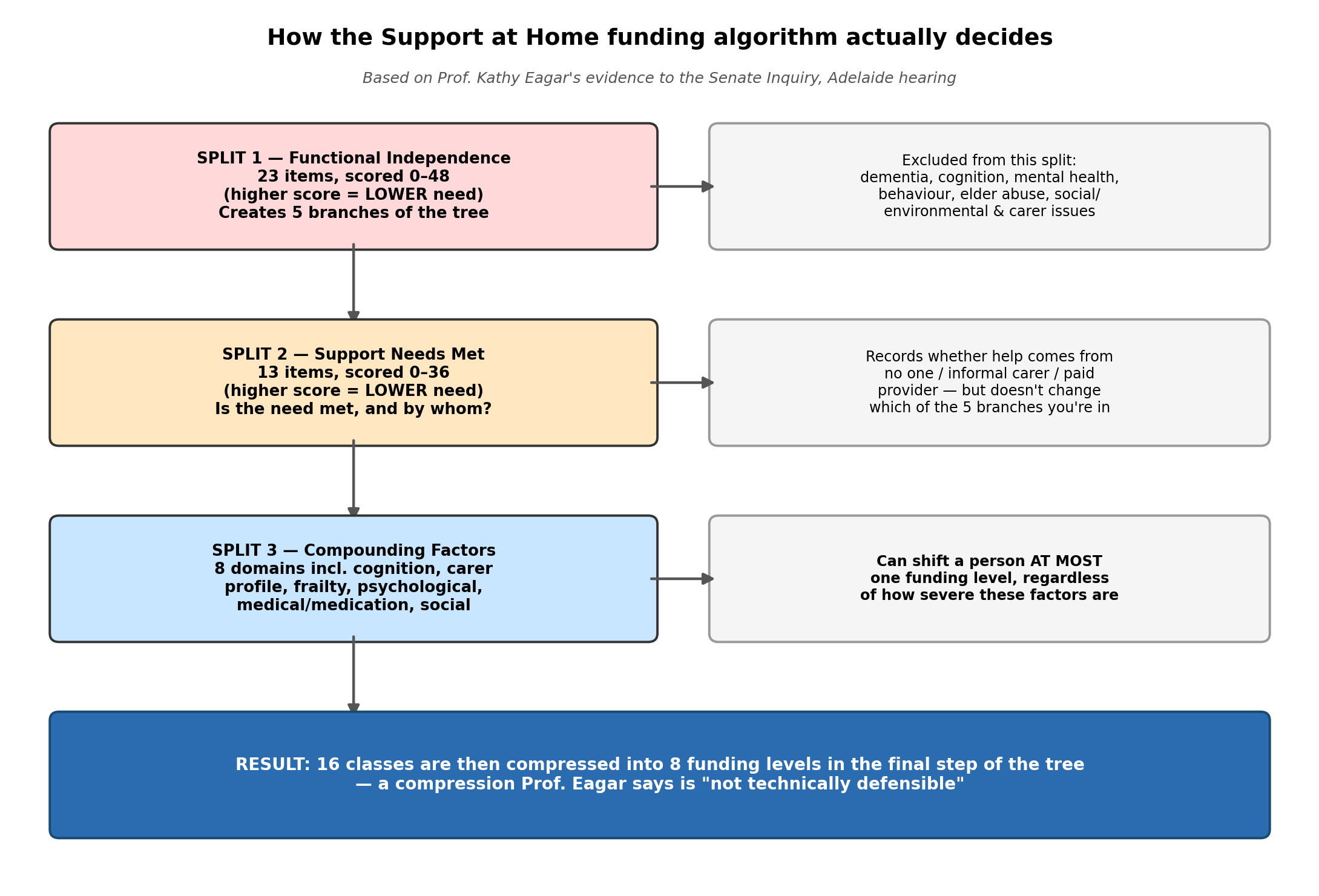
The single biggest determinant of an applicant’s outcome is which of five branches they land in at the very first split of the decision tree. That branch is set using 23 items, introduced in a July 2026 rule change, covering things like walking, climbing stairs, dressing, showering, using the toilet, preparing meals, using a phone or online services, and (newly added this year) whether the client drives and whether they have “health literacy difficulties.”
What is explicitly not counted in that first, most consequential split: dementia, other cognitive problems, mental health conditions, behaviours requiring supervision, elder abuse, social and environmental circumstances, or carer issues.
Before July 2026, the same first split used 33 items, and half of them measured mobility in different ways. As Professor Eagar puts it in her submission: “you could not get into a high funding level if you were mobile.” A person with severe, progressive cognitive decline but who could still physically walk would be routed toward a low funding branch, not because the system made a mistake, but because that is exactly how the branch was defined.
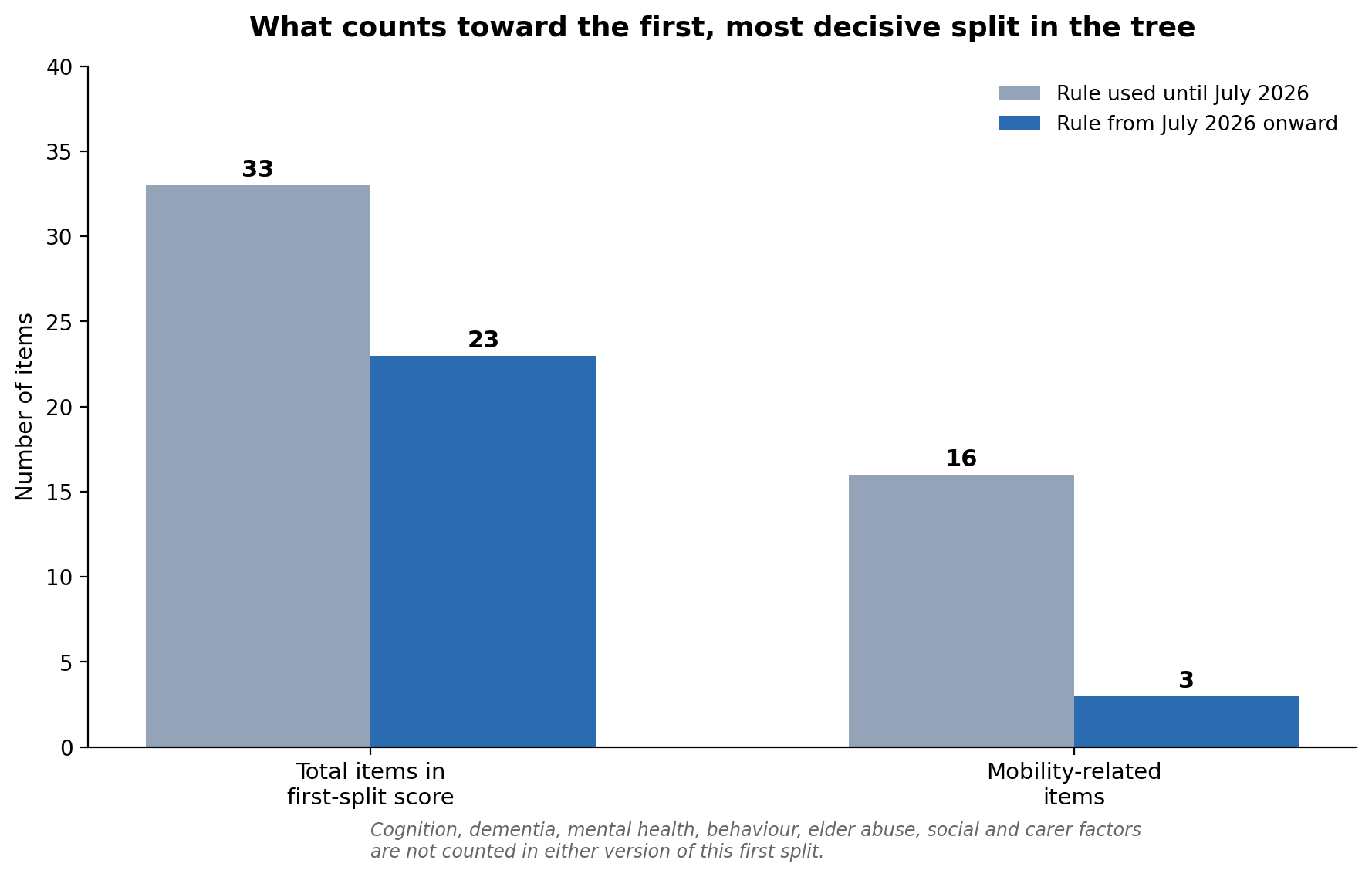
The practical effect, in Professor Eagar’s words, is a scale that is “broad but shallow”: it rewards people who need a little help across many different tasks, and financially punishes people with severe, concentrated limitations in only a few areas, precisely the profile of many dementia and mental illness cases.
Because the underlying scores get sliced into discrete bands, a single point can be the entire difference between one funding level and the next. Professor Eagar’s evidence gives two concrete illustrations: a one-point shift in the functional score, the difference between scoring 24 and scoring 25, produces a $39,000 swing in funding. In two other worked examples from her slides, a single point moves a person’s outcome by 51 per cent, and by 49 per cent, respectively.
The same one-point mechanism decides something even more basic: whether an applicant is routed to the (lower-cost) Commonwealth Home Support Programme or into the Support at Home Program proper. That is determined by one point on the 48-point functional scale.
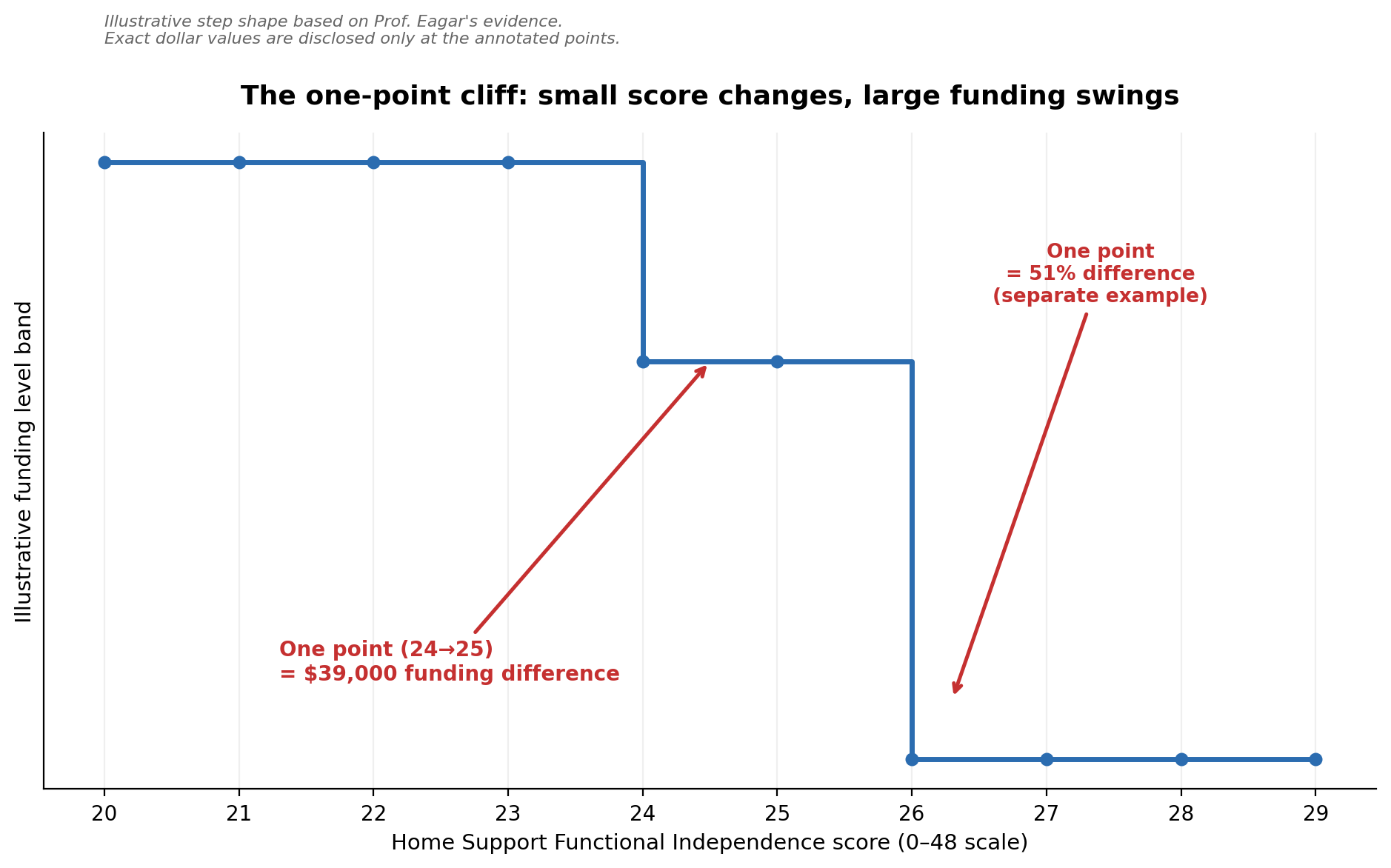
There is no clinical reality in which a person’s actual care needs change by 49 per cent because of a single questionnaire item. What changes is which side of an arbitrary line in the code they land on.
The second branch point, the Needs Met score, asks whether an identified need is being met, and by whom: no one, an informal carer, a paid provider, or someone else. It’s a reasonable question to ask. What it is not designed to do is change which of the five branches from split one a person sits in. A person entirely reliant on an exhausted, unpaid family carer and a person with the identical functional score but full paid support can end up in the same branch, because the branch was already locked in at split one.
The third and final branch split is where cognition, mental health, frailty, elder abuse and carer strain are finally allowed into the calculation, bundled into eight “compounding factor” domains: cognition, medical and medications, social, toileting (bladder and bowel), carer profile, psychological, and physical/personal health and frailty.
Professor Eagar’s assessment of what this achieves: these are “important domains but have minimal impact on funding”, at most moving a person up a single funding level, no matter how severe the underlying need.
A person who is profoundly cognitively impaired, socially isolated, and being cared for by a carer at breaking point can score maximally across all eight compounding domains and still shift only one band from wherever the first split already placed them.
By the time cognitive and psychosocial need is allowed to count at all, it has already been engineered to be nearly irrelevant to the outcome. That is not an unintended flaw discovered after the fact; it is the sequence the tree was built in.
Her submission does not propose patching the algorithm. It concludes that the system is “fatally flawed” precisely because the problem sits in how the top of the tree is defined, which means it “cannot be fixed by minor tinkering down in the branches.” Her recommendations to the inquiry:
None of this is a call to make the algorithm kinder at the margins. It is a finding that the tool was built, split by split, to weight physical function over cognition, and paid-for tasks over frailty and carer collapse, and that no amount of adjustment inside that structure will change what it was built to do.
Professor Eagar gave this evidence to the Senate Inquiry into Support at Home at the Adelaide hearing on Monday 24 August 2026.



Professor Kathy Eagar deserves accolades for her clear and evidential ‘diagnosis’ of the IAT and the consequential outcomes that are affecting older and vulnerable Australians.
Social Isolation has graduated to Social Negation through the system employed by the Commonwealth Health Department Laws. The client is having all aspects that define them subjected to a different interpretation of their entire life’s worth. This is also the basis on which a completely Abusive system is being created. The abuse witnessed in Residential Care Homes was but an introduction to a much worse situation for the client ~ the Aged Resident open to considerable abuse in the “Comfort of their own home”.
As a retired Registered Nurse, involved in the expose that led to the Senator Pat Giles Report in 1983, and subsequent Home and Community Care Program, it has been very disheartening to see what has evolved since that time. Especially given the clarity of the findings of the Royal Commission into Residential Homes.
Thank God for Kathy Eager.
Now the Department has a roadmap to build the right thing. God know what we have paid millions of tax payers’ money for so far!
Professor Kathy Eagar’s analysis of the Integrated Assessment Tool (IAT) is a breakthrough moment for aged care reform. She has done what no one else has been able to do: expose, with absolute clarity, how the current algorithm structurally disadvantages older Australians with dementia, behavioural symptoms, mental illness, frailty, and — critically — carers under extreme strain.
Her work shows that this is not a system suffering from “bugs” or “teething problems.”
It is a system built — split by split — to prioritise physical mobility over cognition, behaviour, psychosocial risk, and carer collapse. And Australians are paying the price.
The fact that more than 80% of the 622 questions in the IAT are not used in any of the three algorithms is indefensible. So is the reality that dementia, cognitive decline, mental health conditions, and carer stress only enter the calculation at the final stage, where they can shift funding by just one level. A single point can swing funding by tens of thousands of dollars. No clinician, carer, or member of the public would consider that fair.
This does not pass the pub test.
And it certainly does not meet the expectations of a country that has already lived through a Royal Commission into Aged Care Quality and Safety.
Carer stress is not a footnote — it is a crisis
Carer strain is one of the strongest predictors of breakdown, hospitalisation, and premature residential care admission. Yet the algorithm treats it as an afterthought. Families who are barely coping — often providing 24/7 care for someone with dementia or complex behaviours — are being funnelled into low‑funding branches simply because the person can still walk.
This is not just clinically unsafe.
It is morally indefensible.
International systems already do this better
Countries like Canada, New Zealand, Denmark, and the Netherlands integrate cognition, behaviour, and carer distress at the front of assessment — not as a minor adjustment at the end. These systems recognise that carer collapse is a major risk factor, not a side issue.
Australia is not attempting something unprecedented.
We are simply implementing it poorly.
Professor Eagar has given us the evidence.
She has shown us the architecture.
She has demonstrated why the system is “fatally flawed” and cannot be fixed with minor tweaks.
Now government must answer the hard questions:
Why was this model chosen?
Why was assessor override removed?
Why were international best‑practice models ignored?
Why is carer collapse treated as a minor variable?
Why are people with dementia and exhausted carers being routed into low‑funding branches by design?
Older Australians deserve a system that sees them — and carers deserve a system that supports them before they break.
Professor Eagar’s analysis is a turning point.
It’s time for government to act like it.
The funding allocation must also be reviewed.
Despite being independently mobile, an NDIS participant living with dementia receives 24/7 support at a 1:3 ratio, while an aged care client receives approximately less than 15% of the equivalent funding, highlighting a significant disparity in funding allocation between the two systems.
I’m one of the people who is experiencing this problem and being declined every time I have an assignment. I’m a Polio survivor experiencing the late effects of Polio/post Polio syndrome. All I want is enough funding to get help to get in and out of bed plus help to shower and dress seven days a week. Where do you find help
It appears that assessment is designed to use emotional conscience of families to support frail relatives to give more support in a bid to cut costs. However on the other side the govt doesn’t hesitate to give more to residential aged care providers and higher co payments. Having said that the current assessment pushes older Australians into residential aged care due to carer strain and hospital bed blocking. Get real. Less more targeted questions in assessment will save money in it self. Forget stupid algorithms and use human assessment to assess human needs.