Markos Klonizakis, Sheffield Hallam University
Swimming, aqua-aerobics, and other water-based exercises are popular for people aged 55 and older to keep fit without putting strain on the joints. Studies show that water-based exercises have many benefits, including improving gait, balance and mobility. It’s also thought to offer benefits as part of rehabilitation programmes for peripheral arterial disease, in which arteries in the legs, stomach, arms and head narrow.
But while water-based exercises are shown to have benefits for other aspects of health, until now there’s been limited evidence on whether it’s as beneficial on reducing cardiovascular disease risk for older adults and improving their heart health.
Our latest study explored the long-term effects of regular, water-based aerobic exercise on cardiovascular health. We proved for the first time that they’re as effective as other types of aerobic exercise for lowering cardiovascular disease risk for older people.
Our study enrolled 80 people over the age of 55 with normal blood pressure and without pre-existing clinical conditions, such as diabetes. We avoided recruiting people who regularly performed high-intensity exercise, such as crossfit. This was to ensure that all the exercise regimes we compared were as similar as possible, and because high-intensity exercise can be difficult to perform in water.
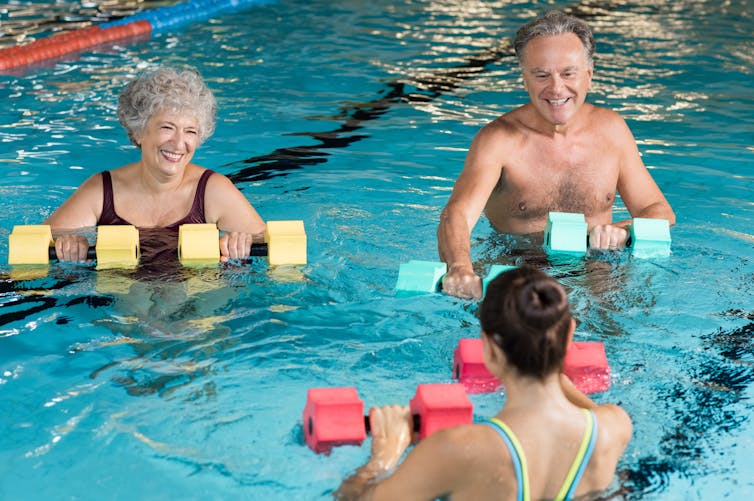
Our participants were exercising on average four times per week, for at least six months. We compared people who trained in the water against those who trained in a gym or took exercise classes, and those who did a mixture of both types of exercises. We also compared this data against a reference group who didn’t exercise at all.
In order to see what effect exercise was having on cardiovascular health, we measured how efficient the inner vein lining (endothelium) of their small veins and large arteries were. Endothelium is crucial for minimising cardiovascular disease risk at any age.
We found that all three modes of exercise offer similar benefits to our arteries and small veins. The mechanism behind these findings isn’t very clear. However, it’s likely that this is because exercise can increase the production of nitric oxide in our body. This is a key component for preserving endothelial function in both small veins and arteries. So the greater the nitric oxide production, the better arteries and small veins can work.
Endothelial function for the exercise groups were also significantly better than the function in the inactive group. This suggests that for older adults, all exercise plays an important role in protecting against cardiovascular disease, whether it’s performed in or out of water.
Cardiovascular disease remains a main cause of death for older people. While exercise – either alone or alongside a healthy diet – can protect against cardiovascular disease, older people often don’t get as much exercise as they should. For example, statistics show that only 13% of women over 75 meet daily physical activity recommendations for their age group.
There are many reasons why older people might not exercise, including fear of injury and lack of confidence in using exercise equipment. But this could mean that they’re missing out on important heart benefits that can protect against cardiovascular disease. This is why promoting forms of exercise that older people feel comfortable doing – and that they want to do – need to be explored and promoted.
This is why our findings may be particularly important, as we’re the first to directly show that water-based exercise is as good for cardiovascular health as exercising in a gym, for the older age-group. This means people can choose a form of exercise that causes less pain, stress, or strain on joints, but will still benefit their heart health. This may be especially good news for people who may be more frail, or for those who are afraid of handling gym equipment.
More research will be needed to better understand why water-based exercise causes these benefits to veins and arteries. But our findings suggest that water-based exercise is an enjoyable way to protect against cardiovascular disease.
Markos Klonizakis, Reader (Clinical Physiology), Sheffield Hallam University
This article is republished from The Conversation under a Creative Commons license. Read the original article.


